 Andrés RM Velarde
You can only move from where you stand.
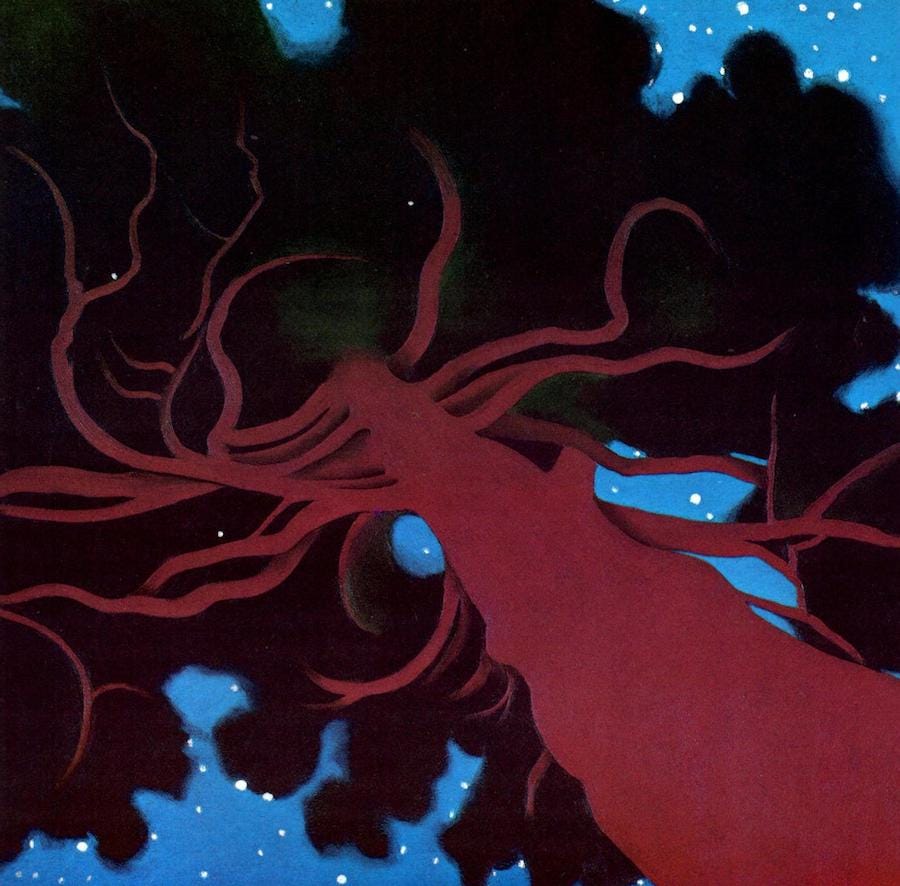
(above) The Lawrence Tree by Georgia O’Keeffe
Dear readers,
Welcome back to another article on my coaching principles. This piece is part of a series of writings that I’m using to reflect more deeply on my belief system as a life and career coach.
Without further ado, let’s dive into my second coaching principle:
You can only move from where you stand.
Goals give you direction. Actions give you information.
A lot of my clients believe that reaching their goals requires an ability to predict, from the beginning, an exact and ideal path to success. They spend so much energy drafting and redrafting a master plan in hopes of landing on a course of action that will guarantee they’ll get what they want.
This prediction is impossible, and it distracts them from a few important truths:
- Despite a master plan, how they’ll reach the goal remains uncertain.
- There is no ideal path to the goal.
- There are infinite paths to the same goal.
I’m NOT saying to throw planning and intentionality out the window. Rather, I’m inviting you to carefully consider the importance and purpose of having personal goals.
Setting specific and measurable goals is critical because it affords you a consistent direction against which you can align your actions. But the actions are the most important part. Because without action there’s a 0% chance of reaching your goal.
Quick Maths:
- Goals without actions = energy expenditure + stagnancy.
- Actions without goals = energy expenditure + getting lost/sidetracked.
The latter equation above is important and, in my estimation, captures the purpose of goal setting: giving you a direction.
I think of goals like a compass. My goals can tell me which direction to go generally, but they can’t tell me which steps to take along the way.
That’s where my actions or habits come into play. Actions are an important method of gathering information. When I take an action, I trigger downstream outcomes, consequences, or results. Whatever you call them, they’re information you can use. You can reflect on this info and learn:
- Am I still facing in the direction of my goal?
- Do the observed outcomes bring me closer to or farther from my goal?
- What new info emerged and how might it inform what I try next?
Actions help you map your step-by-step path in real time. Goals keep you facing the correct direction each step of the way. You need both because they work together! But lowkey, my bias is for action, and that’s what this second principle is really all about. Allow me to explain.
Attention is better spent focused on what’s within our control.
The Nth step in your master plan is not within your control. At least now right now. But the 1st step is very much within your control! So choose to focus your attention on the action immediately before you.
Don’t get me wrong. Spend some time considering the Nth order consequences or potential downstream decision points, but try to accept that they’re imaginary and only exist in the future vision of your mind’s eye, not reality.
Keep taking action and eventually you’ll arrive at step N, which, by that point, will become a new step 1.
For me, moving from where you stand is a powerful reminder of action as a tool. Namely, taking action is the best tool I have for quickly resolving uncertainty into certainty — into cold, hard observable outcomes.
Moving from where you stand also folds nicely into my first coaching principle: You already have what you need within. (click to read more). I love this quote from the stoic Marcus Aurelius, and I reflect upon it whenever I find myself worrying about the Nth step instead of considering the one immediately before me:
Never let the future disturb you. You will meet it, if you have to, with the same weapons of reason which today arm you against the present.
The tools I need to act exist within me, always. They cannot be taken from me, not at step 1 or step N. Trusting my self-knowledge and goals is how I continue to make decisions that are in my best interest.
You don’t need to have all the answers.
There’s a great quote by the author E.L. Doctorow, which applies to life as much as it does to writing:
Writing is like driving at night in the fog. You can only see as far as your headlights, but you can make the whole trip that way.
You don’t need to have all the answers. You can act in the face of overwhelming uncertainty and incomplete information. Take the next immediate step, no matter how small it might feel. You don’t need to be able to see the entirety of the road before you. You just have to take the next action and the road will become slightly more illuminated. Not fully, but a little.
TL;DR: Fuck around, find out. Action begets information. You can’t predict the future, nor control it. But you can control your next action!