 Andrés RM Velarde
Becoming is a process with no end.
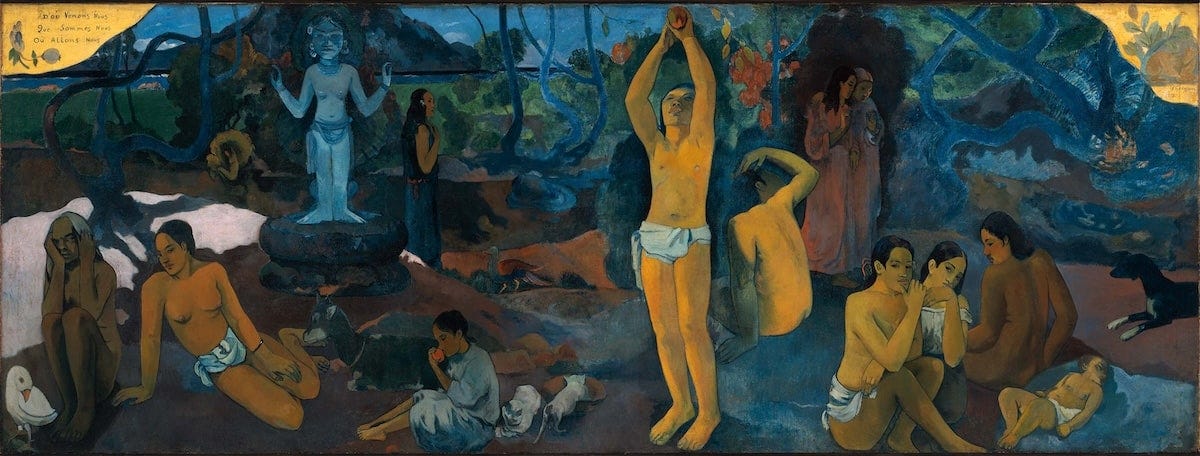
(above) Where Do We Come From? What Are We? Where Are We Going? by Paul Gauguin
Dear readers,
If you’ve been following along, you know this piece is part of a series of writings I’m using to shine light on my belief system as a life and career coach. At a high level, you can read about each of my coaching principles here. But I think they each deserve more exposition. Today’s principle:
Becoming is a process with no end.
The superlative does not exist.
I don’t believe in enlightenment, self-actualization, or peak performance. I reject the superlative because I think we always have the capacity to learn and grow further, no matter how much we’ve achieved so far.
You may be the most worshiped and decorated “expert” in your field, and, nevertheless, there are still ways you can improve your craft. And if you don’t believe so, then you are no expert in my opinion.
In the beginner’s mind there are many possibilities, but in the expert’s there are few. ~ Shunryu Suzuki
Continuous improvement was a mindset hammered into me as a young chemist, when I was running experiments to optimize materials formulations. The recipes would contain dozens of ingredients, meaning that the number of possible formulations was practically endless. It would be impossible to test each one. So the best alternative was to simply improve in each iteration.
Continuous improvement speaks to the compounding effects of small process changes. This is the basis of Lean Six Sigma and James Clear’s Atomic Habits, two frameworks that have also influenced and informed this coaching principle.
I think the mindset of continuous improvement transfers well to human development, and parallels growth mindset. But I’ll have to be delicate here, because we humans are messy, emotional creatures.
If we always have to strive, will we ever be good enough?
Yes, I believe we can always do better. There are always steps we can take to align our lives (actions) a little bit more with our values. We’ll never be perfect. All that’s within our control is that we keep trying. Keep striving. Never stop. Don’t stop. Can’t stop. Oh God! Why can’t I stop!? Please I just want to stop already! Fuck!
Do you see where I’m going with this?
Continuous improvement can be an exhausting way to view your life and personal development. And, to be honest, it’s kind of a robotic, unfeeling way to experience reality. After all, we’re not productivity machines. Our successes are not widgets being cranked out on a manufacturing line.
In some ways, commitment to continuous improvement, or having a growth mindset, is a heavy burden to bear. I’ve seen countless high achievers continue to strive, feeling like they never quite arrive. They blow past each milestone, each win, continually chasing down a goal post that moves elusively further and further away. Many of these people then begin to wonder, as the weight of burnout descends upon them, “Will I ever arrive? Will I ever be good enough?”
This line of questioning is pernicious and drains our energy. So how do we expand our energy in the process of becoming?
The law of conservation of energy does not apply to the energy of your spirit.
The trick to avoiding burnout and alleviating yourself from the burden of continuous improvement is to learn to love the process. Loving the process creates the energy we need to persist. You heard that right. We can create energy. Take that, physicists.
You can learn to love the process by:
- Reminding yourself that you get to do this. You don’t have to do this.
- Celebrating your wins, no matter how small.
- Staying present and looking for joy in the process in each passing moment.
- Accepting that there is no end point.
A few words on each of the above ideas:
You choose the games you play. You’re not forced to play.
One of my favorite books of all time is James P. Carse’s Finite and Infinite Games. He describes finite games as “played for the purpose of winning” and infinite games as “played for the purpose of continuing to play.”
He goes on to describe how finite games have defined boundaries, fixed rules, and, therefore, a clear winner. Importantly, when someone wins, the game ends. Think: chess, politics, warfare.
On the other hand, he shows how infinite games have evolving rules, open boundaries, and continually welcome new participants. Think: love, artistic expression, how you choose to live.
One of Carse’s principles of finite and infinite games, alike, is “that whoever plays, plays freely. Whoever must play, cannot play.”
And herein lies one root of suffering. High achievers often feel obligated to keep striving, and lose sight of their agency. The reality is, they can sit back and chill if they want. But they don’t want. So they choose to strive.
So, chill. You’re not a victim, especially of your own striving. You may also choose to rest, and you should when it makes sense to do so.
Celebration cultivates presence. The process is the reward.
I see clients push and push toward their goals, hit meaningful milestones, but push blindly past them in ravenous pursuit of the next goal, or worse, some “ultimate goal.”
Talk about missing a great opportunity to stop and smell the roses, to take in the views. Many of us, myself included, struggle to be present enough to notice the wins along the way. Especially the small ones. We don’t celebrate the days when we do the bare minimum. We don’t celebrate the days when we do the most.
And the consequence of not celebrating is brutal. With each milestone that we miss noticing, we’re left with a growing, hollow feeling that no matter what we do, it’ll never be enough, that we’ll never arrive.
News flash: there is no arrival destination!
All there is is the process. All there is is the journey. It sounds cliché, but clichés exist for a reason. There is truth to them.
Celebration is how you train yourself to be present and learn to love the process.
Do it for the plot.
Sometimes when I’m stuck in analysis paralysis, afraid to make my next decision because I don’t know where it will lead, my lovely wife will encourage me to “do it for the plot.”
In these moments she reminds me that sometimes things are worth doing simply for the sake of doing them, not because they’re a means to a predictable end.
Throughout my life, I’ve realized that the more I can learn to love and appreciate the process of whatever I’m doing — the iterative cycle of action, reflection, and further action — the more I can find present fulfilment.
I used to perpetually push off experiencing joy and satisfaction to some future time, when I imagined my accomplishments would finally be worthy of celebration.
But now I refuse to exist this way. Because, after all, tomorrow isn’t promised. If we keep chasing the pot of gold at the end of the rainbow, we’ll never really see the spectacular show of colors and light right under our preoccupied little noses.
This is a beautiful journey we’re on, friends. Enjoy it while it lasts.
Life is not a problem to be solved, but a reality to be experienced. ~ Søren Kierkegaard
TL;DR: Celebrate your wins. But winning is not the point. The point is to keep going, to keep improving. And in this endeavor, the process is all there is. Learn to love it.
With gratitude,
Andrés RM Velarde